
Hate Will Return!
From Cinematic Warning to Reality: Two 2019 Films That Predicted America's Future.
Author:
Fouad Shabani
Researcher in Strategic Studies
August 16, 2026
In 2019, two films with different yet convergent narratives unveiled a hidden truth: "Official Secrets" told the story of a conscientious whistleblower standing against the war machine, and "Angel Has Fallen" warned that the President himself could become the target of a conspiracy from within the system. Today, in 2026, both scenarios are unfolding not on the silver screen, but in the most nightmarish form possible within the arena of American politics. Relying on the concept of the "chain of hatred's return," this article argues that the leaking of information regarding the attack on Iran, the warning from 400 former security officials, and the assassination plots against Trump are all links in a chain where hatred born of warmongering returns to its origin—not directly, but through the path of public conscience and internal institutional structures. Hollywood cinema in 2019 was not a prediction, but a warning for a future that has now arrived.
Introduction: The Year Hollywood Came Close to Truth
The year 2019 was a year full of films for American cinema about the threat of intelligence agencies, the leaking of secrets, and internal conspiracies. Two standout films from that year, although in different genres, both addressed a fundamental question: Can anonymous structures within the American political system be the ultimate decision-makers?
"Official Secrets" told the story of a real-life whistleblower who, by revealing classified information, tried to stop an unjust war. "Angel Has Fallen," however, approached the question from another angle: What happens if the President himself becomes the target of a conspiracy from within the system?
Today, in the year 1405 (2026 CE), both films are closer to reality than ever before. Official reports regarding Trump's claim about the leak of information on the attack on Iran, and the warning from 400 former security officials about the "removal of democratic safeguards," show that Hollywood may have been closer to the truth than we thought. But the fundamental question is: Why have these predictions come true? The answer must be sought in the concept of the "chain of hatred's return"—a concept that states hatred born of oppression and warmongering never goes unanswered, but its answer is not always direct and from the victim; sometimes, the public conscience of a nation deems itself responsible for returning that hatred to its source.

Film One: "Official Secrets" and the Redeeming Whistleblowing
A Woman's Story Against War
In 2019, the film "Official Secrets," directed by Gavin Hood, was released—a narrative of the real life of Katharine Gun, a translator for the British intelligence agency GCHQ, who, on the eve of the 2003 Iraq War, leaked a top-secret memo. That memo revealed the U.S.'s illegal request to spy on members of the UN Security Council to sway their votes for a war resolution.
Aware that this action was a "breach of the Official Secrets Act," Gun copied and leaked it to the press. Her motive? Not fame, not politics; only conscience and a small hope of stopping a great war. Her efforts were ultimately in vain, but she put herself and her husband at great risk.
The film poses a fundamental question to its audience: "How loud is the voice of an ordinary citizen in a democratic society?"
When Film Meets Reality
Now, more than two decades after Katharine Gun's story, a similar but inverted scenario is unfolding. Donald Trump, the President of the United States, claimed in a recent press conference that the U.S. intended to carry out the strongest attack against Iran but backed down after information was leaked. According to Trump, "The leaked information revealed the scale of the planned attack and informed Iran about what was going to happen."
Media have also reported that American media outlets revealed the precise details of the attack, including the timing and targets, forcing Trump to halt the operation. According to some reports, Trump has canceled the attack on Iran at least five times at the last moment since April 2026.
On another level, former U.S. security officials have warned that Trump in his second term has "acted like a dictator and weakened the checks on executive power." A network of over 400 former intelligence and security officials, called "The Steady State," has warned that "all mitigating safeguards and oversight barriers have been removed."
This is where the chain of hatred's return takes shape: The leaking of information, although carried out by anonymous sources, resulted in halting a war that could have killed thousands of Iranians and Americans. This act of disclosure was not born of individual conscience (as the identity of the leakers is unknown), but from the public conscience of an intelligence system unwilling to bear responsibility for mass killing. In other words, the hatred for the war Trump intended to start did not return from Iran, but from within the American system itself to its origin.
---
Film Two: "Angel Has Fallen" and the President Who Becomes a Target
Trumbull: A President with a Familiar Name
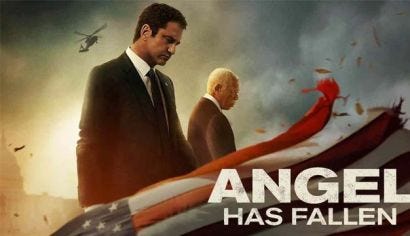
In the film "Angel Has Fallen," released also in 2019, the U.S. President is named Allan Trumbull—a name that, with a slight rearrangement, resembles Donald Trump. In the film, Trumbull becomes the target of a deadly assassination attempt, and a conspiracy is hatched against him from within the Secret Service and intelligence agencies. The special agent (Gerard Butler) must go on the run and find the conspirators himself to prove his innocence.
Reality: The Warning of 400 Former Officials About "Eliminating" Trump
But this is not just a Hollywood action flick. In the real world, a group of 400 former U.S. national security and intelligence officials, called "The Steady State"—which, according to the Financial Times, was formed in 2016 based on warnings about the "escalating trend of authoritarianism"—now warns that Donald Trump, in his second term, has removed all mitigating safeguards and oversight barriers, and this trend threatens not only American democracy but also the business environment and institutional stability.
Marc Zaid, a national security lawyer who himself was a victim of Trump's security clearance revocation, said in this regard: "All mitigating safeguards and oversight barriers have been removed, while I think we haven't even come close to the worst part of this process."
Gail Helt, a former CIA analyst, told the same Financial Times report: "Trump is creating a personality cult for himself. He wants his image printed on our passports and money; while even someone like Mao didn't want his image on his country's currency."
Meanwhile, the U.S. Department of Justice has charged eight men with conspiring to assassinate Donald Trump and his running mate JD Vance at a UFC event. The defendants allegedly planned to attack them with explosive drones and snipers. This reality bears an alarming resemblance to the film "Angel Has Fallen," where President Trumbull becomes the target of an assassination conspiracy from within the system.
The Return of Hatred Through the Path of Public Conscience
Here too, the chain of hatred's return operates indirectly. Hatred of Trump's warmongering and authoritarian policies manifests not as direct revenge from Iran or foreign enemies, but as a collective warning from 400 former security officials and even assassination plots (however illegal). It is the public conscience of a political system that refuses to accept responsibility for choosing a warmongering president and therefore seeks tools to return the hatred to its source—namely Trump himself and his power structure.
John Brennan, former CIA director, has repeatedly called for the activation of the 25th Amendment (to declare the President incapacitated). Democrats have also recently proposed a bill to form a 17-member committee to assess Trump's ability to continue as president. These are all signs of "indirect retribution," where the injured party (which here could be the Iranian nation or even the American people) is not the actor, but rather the public conscience of institutions and citizens takes it upon itself to return the hatred to its origin.
---
Two Films, Two Sides of the Same Coin; Redeeming Whistleblowing vs. Internal Conspiracy
In "Official Secrets," Katharine Gun stands against the power structure; by revealing the truth, she challenges a system that built a war on lies. Here, the whistleblower is the hero, even if she pays a price. Gun was pursued and arrested, charged with "breach of the Official Secrets Act," but her goal—informing public opinion and preventing civilian casualties—made her a moral figure.
In "Angel Has Fallen," however, the power structure itself conspires against the President. Here, the system is the conspirator, and the President is the victim. Anonymous conspirators within the intelligence services seek to change power and eliminate the President, and this is precisely the scenario that some of Trump's opponents—whether through the 25th Amendment or extra-legal means—are contemplating today.
But in the real world, both scenarios are occurring simultaneously. On the one hand, the leaking of information about the attack on Iran (similar to the first film) stopped a war and perhaps saved thousands of lives. But unlike the film, where the whistleblower's motive was "conscience," in Trump's case, the motive of the anonymous sources is still unclear, and Trump himself is furious with the "internal leakers" and has ordered an investigation to find the source of the leak.
On the other hand, the warning from 400 former security officials (similar to the second film) shows that the President himself is destroying institutions, and this destruction sets the stage for an even greater crisis. Paul Kolb, a former CIA station chief, has compared this situation to "The Dictator's Handbook."
---
Conceptual Analysis: How Does the Chain of Hatred's Return Form?
The concept of the "chain of hatred's return" is rooted in the idea that hatred born of oppression and violence never moves in one direction and never goes unanswered. But the response to hatred is not always direct and from the primary victim. Sometimes, hatred returns through more complex paths:
1. Direct Retribution by the Injured Party: In this case, the victim responds directly to the aggressor. But in international politics, this often leads to full-scale wars with heavy costs that many countries avoid.
2. Retribution by the Public Conscience of a Country: This occurs when the people or institutions of a country feel responsible for stopping the oppression of their own government. Here, the hatred born of a president's warmongering, instead of being directed at a foreign enemy, returns inward and targets the government. The leaking of information about the attack on Iran by anonymous internal sources, and the warning from 400 former security officials, are clear examples of this type of hatred's return. These individuals and institutions, aware of the consequences of war, prefer to return the hatred to its source—the White House and the war decision-makers—rather than allow it to be directed towards Iran and cause a human catastrophe.
3. Retribution Through Legal and Extra-Legal Structures: Efforts to activate the 25th Amendment, or even assassination plots (however illegal), represent different forms of hatred's return. In these cases, the public conscience, unwilling to accept responsibility for choosing a warmongering president, resorts to various tools to strip him of power.
In the case of Trump and Iran, all three types of hatred's return can be observed:
· Direct type (Iran's threat of military response), although present at the rhetorical level, has not been practically implemented due to the balance of power and heavy costs.
· Indirect type through public conscience (leaking information by internal sources, warnings from former officials) is actively occurring and has even managed to stop the attack.
· Structural type (attempts at impeachment, the 25th Amendment, and even assassination plots) is also taking shape as a reaction to Trump's authoritarian behavior.
---
Conclusion; Cinema, Foresight or Warning?
In 2019, Hollywood made two films, both in some way about the battle of information, power, and whistleblowing. Today, in 2026, both films have come strikingly close to reality.
The redeeming whistleblowing (like in "Official Secrets") managed to stop the attack on Iran and perhaps prevent a global war. But at the same time, Trump uses the leak to justify his actions while simultaneously weakening opponents and oversight institutions.
Internal conspiracies (like in "Angel Has Fallen") have also been raised more seriously; where 400 former security officials warn that the President himself threatens democracy, and at the same time, opposition groups use legal and extra-legal tools to remove him.
But the greatest lesson these two films and today's events offer us is the emphasis on the concept of the "chain of hatred's return." Hatred born of warmongering and oppression never disappears; it only changes course. If the direct victim (Iran) cannot or will not respond directly, the public conscience of the oppressor country will deem itself responsible for returning that hatred to its source. The leaking of information about the attack on Iran, the warning from 400 security officials, and even the assassination plots, are all links in this chain.
Perhaps the Hollywood filmmakers in 2019, more than they knew, were delivering a more serious warning about America's political future—a future where the President is either eliminated by the "shadow government," or he himself so destroys democratic institutions that nothing is left to eliminate. But more importantly, they showed that hatred, like a boomerang, always returns to the one who threw it—though its path may be long and complex.
And today, in the year 1405, this return is occurring. Not from Iran, but from within America itself. Hate will return, and this time, its origin is the White House.
---
Sources
1. Film "Official Secrets," directed by Gavin Hood, 2019
2. Film "Angel Has Fallen," directed by Ric Roman Waugh, 2019
3. Financial Times report on "The Steady State" network and the warning from 400 former security officials regarding Trump's actions in his second term
4. Statements by Donald Trump in a press conference regarding the claim of leaked information on the attack on Iran and the cancellation of military operations
5. U.S. Department of Justice report on charging eight men with conspiracy to assassinate Donald Trump and JD Vance
6. Statements by John Brennan, former CIA director, on the necessity of activating the 25th Amendment of the U.S. Constitution
7. Media reports on the cancellation of the attack on Iran by Trump at least five times at the last moment (April 2026)
Hatred doesn't only return through external means, such as assassination or legal retribution. It actually returns at source. I don't know if it says it in the Qu'ran, but in the Bible, Ecclesiasticus 13:1 says "He who toucheth pitch shall be defiled." You let hatred fester in you, you fester yourself.
I never met anybody who was happy with their hatred. My Dad always said "What you are eventually shows up on your face" - you look at trump now, when he's not trying to charm the voters. That man is festering hard.